
House edge is the percentage of money a casino mathematically expects to retain from wagers over the long run. For example, a game with a 5% house edge has an expected long-term casino advantage of $5 for every $100 wagered, although individual players can win or lose much more in the short term.
If you’ve spent any time around gambling — whether at a casino floor, an online slot, or a poker table with friends — you’ve probably heard the phrase “the house always wins.” It sounds like a cliché, but it’s rooted in something very real and very precise: a mathematical concept called house edge.
House edge is the single most important number in gambling that almost nobody actually understands. It’s printed in tiny disclaimers, buried in game rules, and referenced constantly by gambling forums — yet most players could not tell you what it actually means, how it’s calculated, or why it matters more than luck itself.
This article breaks house edge down in plain language: what it is, how casinos calculate it, why it’s different from “odds,” and how it quietly determines the outcome of nearly every bet you’ll ever make.
Quick Answer: What Is House Edge?
- Definition: The casino’s mathematical advantage over players.
- Expressed as: A percentage.
- 5% house edge: $5 expected casino advantage per $100 wagered over the long run.
- RTP relationship: House edge = 100% − RTP.
- Important: It does not predict the result of one spin, hand, or session.
| Game | Typical House Edge | Important Variable |
|---|---|---|
| Blackjack | ~0.5%–2% | Player strategy and rules |
| Baccarat Banker | ~1.06% | Bet type |
| European Roulette | 2.7% | Single-zero wheel |
| American Roulette | 5.26% | Double-zero wheel |
| Slots | Varies | RTP and game configuration |
| Video Poker | Varies | Paytable and strategy |
What Is House Edge, Exactly?
House edge is the mathematical advantage a casino holds over players in any given game, expressed as a percentage of each bet the casino expects to keep over the long run.
For example, if a game has a house edge of 5%, the casino expects to keep, on average, $5 out of every $100 wagered over time. The other $95 gets paid back to players as winnings.
That’s the key phrase: over time. House edge is not a prediction about any single spin, hand, or roll. It’s a statistical average that only becomes visible after thousands or millions of bets. On any given night, a player can win big despite a high house edge, or lose steadily despite playing a “good” game. House edge describes the casino’s business model, not your personal outcome.
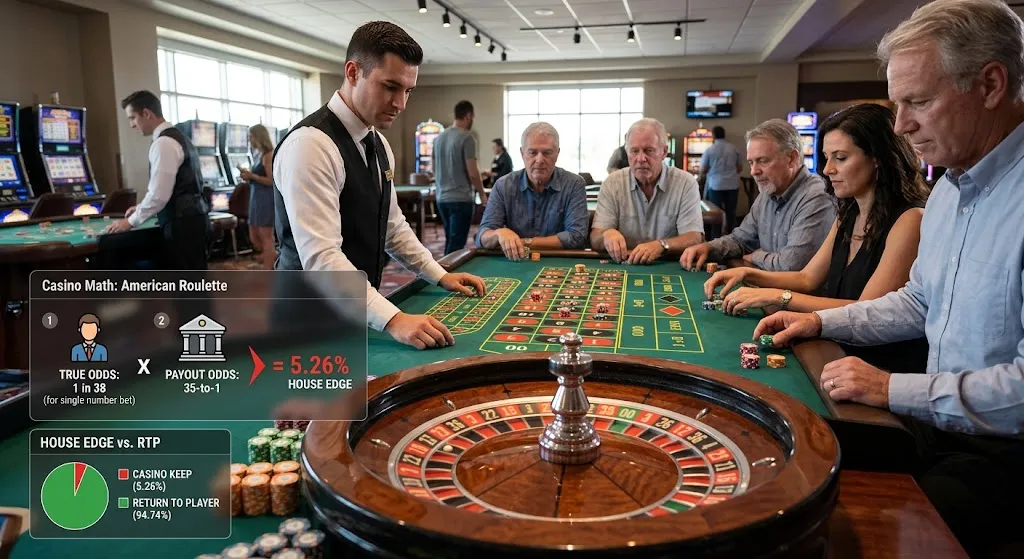
The Simple Formula Behind House Edge
At its core, house edge comes from comparing two things:
- The true odds of an event happening (the mathematically fair probability)
- The payout odds the casino actually offers you
Whenever those two numbers don’t match and the gap between them is the house edge.
A Simple Example: The Coin Flip Bet
Imagine a casino let you bet on a coin flip, but only paid out 0.95-to-1 instead of the fair 1-to-1.
- True odds of winning: 50%
- Fair payout would be: even money (bet $1, win $1)
- Actual payout offered: $0.95 for every $1 bet
That small shortfall — 5 cents on every dollar — is the house edge. It’s not that the coin is rigged. It’s that the payout is slightly less than what fairness would demand. This is exactly how real casino games work: the probabilities are usually fair (or close to it), but the payouts are typically trimmed just enough to guarantee the casino a long-term profit.
House Edge vs. RTP: What’s the Difference?
You’ll often see house advantage mentioned alongside another term: RTP, or Return to Player. These two numbers are mirror images of each other.
- House Edge = the casino’s theoretical long-term advantage, expressed as a percentage of total wagers.
- RTP = the percentage returned to players
For the same game or wager, theoretical RTP and house edge are complementary measures: house edge = 100% − RTP. A slot machine with a 96% RTP has a 4% house edge. A roulette wheel with a 94.74% RTP (American double-zero roulette) carries a 5.26% house edge.
Online casinos tend to advertise RTP because it sounds more player-friendly (“96% return!”), while the underlying math is identical to house edge. Understanding both terms lets you see through marketing language and compare games on equal footing.
House Edge at a Glance
| Question | Answer |
|---|---|
| What is house edge? | The casino’s theoretical mathematical advantage over players. |
| How is it expressed? | As a percentage. |
| What does 5% mean? | About $5 expected loss per $100 wagered over the long run. |
| What is the formula? | House edge = 100% − RTP. |
| Does it predict one bet? | No. |
| Can strategy reduce it? | In some games, yes. |
House Edge Across Popular Casino Games
House edge varies dramatically depending on the game, and even depending on how you play it. Here’s how it breaks down across some of the most common games.
Blackjack: 0.5% – 2%
Blackjack has one of the lowest house edges in the casino, but only if played with correct basic strategy. Deviating from optimal decisions (like never hitting on a soft 17, or always standing on 16) can push the house edge up several percentage points. This is one of the few games where player skill directly changes the math in real time.
Baccarat: 1.06% – 14.4%
Banker: about 1.06% Player: about 1.24% Tie: typically around 14%+, depending on payout rules
Betting on the Banker hand carries a house edge of about 1.06%, making it one of the best bets in the casino. Betting on Player raises it slightly to 1.24%. The Tie bet, however, carries a brutal house edge often above 14%, despite its tempting payout — a classic example of a bet that looks generous but is mathematically terrible.
Craps: 0% – 16.67%
Craps offers some of the widest range of any casino game. The Pass Line itself has a house edge of about 1.41%. The additional odds bet has 0% house edge, but it doesn’t eliminate the edge on the Pass Line wager. Craps rewards players who know exactly which bets to make and which to avoid.
Roulette: 2.7% – 5.26%
European roulette (single zero) has house edge of 2.7%. American roulette (double zero) nearly doubles it to 5.26%, simply because of one extra number on the wheel. This is a rare case where the exact same bet, on a visually similar game, can carry almost twice the cost depending on which version you’re playing.
Slot Machines: 2% – 15%
Slot house edge varies widely because RTP differs by game, configuration, jurisdiction, and sometimes denomination.
House edge = 100% − RTP
96% RTP = 4% theoretical house edge.
Because outcomes are randomized by a certified algorithm rather than physical odds, players have no way to shift the math through strategy — in slots the outcome of each spin is determined independently by the game’s RNG, while players can sometimes choose between games with different RTP and volatility.
Video Poker: 0.5% – 5%
Like blackjack, video poker rewards correct strategy. Certain full-pay variants of Jacks or Better can have a house edge under 0.5% — among the best odds in any casino — but the exact paytable matters enormously. Two machines that look identical can have very different house edges depending on the payout table for a full house or flush.
Why House Edge Guarantees Long-Term Casino Profit
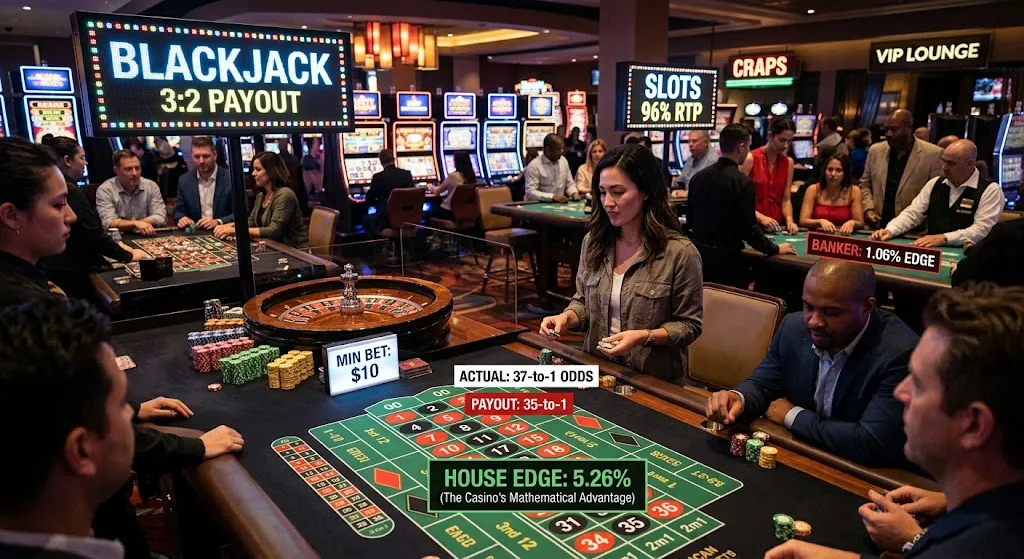
This is where the law of large numbers comes in — the statistical principle that makes casinos reliably profitable businesses rather than gambling houses hoping for luck.
A single roulette spin is unpredictable. A single hand of blackjack is unpredictable. But a casino isn’t running a single spin — it’s running millions of them, across thousands of players, every single day. As the number of bets increases, actual results converge closer and closer to the mathematical expectation set by the house edge.
This is why casinos are comfortable letting individual players win large jackpots. One $50,000 slot win doesn’t threaten the business, because it’s already priced into the math across millions of other spins that lose smaller amounts. The statistical advantage (of the casino) doesn’t need to win every hand — it just needs enough hands to smooth out into predictable, repeatable profit.
Common Misconceptions About House Edge
“A low house edge means I’ll probably win.” Not necessarily. A low house edge affects your expected losses over time, not your odds on any single session. Variance — the natural swing of short-term results — can still produce a losing night even on a favorable game.
“Expected casino profit margin means the game is rigged.” House edge isn’t the same as rigging. In regulated casinos, the underlying probabilities are certified and fair; the house edge comes from payout structure, not manipulated outcomes. A fair coin flip paying less than even money isn’t a rigged coin — it’s an unfair payout.
“Betting systems can beat the house edge.” Strategies like the Martingale system change how you distribute your bets, but they cannot change the underlying house edge itself. No betting pattern alters the mathematical probability baked into the game.
“All versions of a game have the same casino advantage.” As shown with roulette (2.7% vs 5.26%) and video poker (0.5% vs 5%+), small rule differences can dramatically shift the house edge. Always check the specific variant and paytable, not just the game’s general name.
How to Calculate Your Expected Loss
Once you know a game’s house edge, you can turn it into a concrete number using one simple formula:
Expected loss = total amount wagered × house edge
This formula tells you, mathematically, what a casino expects to keep from your play over time — not from a single bet, but from the total volume of money that passes through the game. Take a game with a 5% house edge as an example:
- Wager $100 → theoretical expected loss of $5
- Wager $1,000 → theoretical expected loss of $50
- Wager $10,000 → theoretical expected loss of $500
Notice that “wagered” doesn’t mean the amount you brought to the table — it means the total amount you bet across every hand, spin, or roll, including money you win and then bet again. A player who buys in for $200 but bets through $3,000 over the course of a session is being measured against that $3,000 figure, not the $200 they started with. This is why a modest bankroll can still produce a large total wagered amount over a long session of fast-paced play.
It’s important to be precise about what this number actually represents. Expected loss is a long-term mathematical average, not a forecast of what will happen in any single session. It describes where results converge if the same bet were placed millions of times under identical conditions — the same idea behind the law of large numbers discussed earlier. On any individual night, actual results can and do swing far above or below this number in either direction. A player could wager $1,000 on a 5% house edge game and walk away up $200, or down $400; both outcomes are entirely consistent with a “$50 expected loss,” because that figure is an average across countless repetitions, not a guarantee for any one of them.
Where the formula becomes genuinely useful is in comparing games and estimating the realistic cost of play over time — for a long session, a full trip, or a year of regular visits, where variance tends to smooth out and results drift closer to the theoretical expectation. Used this way, expected loss turns an abstract percentage into a concrete number you can actually plan around.
How to Use House Edge as a Player
Understanding casino edge won’t guarantee winning, but it puts you in control of an important decision: which games are worth your time and money.
- Compare games by their edge, not their excitement. A flashy slot with a 12% house edge is mathematically worse than a plain blackjack table at 0.5%.
- Look for the best version of a game, not just the game itself. European roulette over American. Full-pay video poker over reduced-pay machines. Banker bets over Tie bets in baccarat.
- Treat house edge as the cost of entertainment. Framing gambling as “paying for the experience” at a known statistical cost — rather than as a source of expected income — tends to lead to healthier, more informed decisions.
- Remember variance is real. Short sessions can and do deviate from the house edge in either direction. That unpredictability is part of what makes gambling gambling — but it doesn’t change the long-run math working against the player.
The Bottom Line
House edge is the quiet mathematical engine behind every casino game, from the flashiest slot machine to the simplest coin-flip-style bet. It’s not about luck, rigging, or superstition — it’s a straightforward percentage that tells you exactly how much of every dollar wagered the casino expects to keep over time.
Games differ enormously in how player-friendly their built-in house percentage is, and even small rule variations can shift that number significantly. Knowing how to read and compare house edge doesn’t guarantee a win, but it does let you understand exactly what you’re paying for the entertainment — and which games give you the best mathematical value for it.
Frequently Asked Questions
What is a good house edge in a casino game?
Generally, a house edge below 1.5% is considered favorable to players. Blackjack with basic strategy, baccarat’s Banker bet, and full-pay video poker are among the games that reach this range.
Does house edge change based on how much I bet?
No. House edge is a percentage that applies consistently regardless of bet size. Betting more simply increases the dollar amount the house edge applies to — it doesn’t change the underlying percentage.
Can a player ever have an edge over the casino?
In rare cases, such as advantage-play blackjack (card counting) or certain promotional bets, players can theoretically shift the math in their favor. Casinos actively monitor for and restrict these situations.
Is house edge the same in every country or casino?
No. Rules, paytables, and even the number of zeros on a roulette wheel vary by casino and jurisdiction, all of which directly affect the house edge for the same nominal game.
Why can slot games have a higher house edge than some table games?
Slots require no player skill and combine entertainment features (bonus rounds, progressive jackpots, animations) into their cost structure, which is generally reflected in a higher house edge compared to skill-based table games like blackjack.
How Is House Edge Calculated? House edge = 1 − expected return to the player or, expressed as a percentage:
House edge (%) = (1 − RTP) × 100
Example: 96% RTP → 1 − 0.96 = 0.04 → 4% house edge
Sources
- UK Gambling Commission — Return to Player: How Much Gaming Machines Payout
Explains that %RTP is an average achieved over a significant number of plays, not on any single play, and covers how RTP relates to prize amounts across gaming machine categories.
UK Gambling Commission — Return to Player - UK Gambling Commission — Gaming Machine Payouts: Return-to-Player
Regulatory guidance requiring licensed gaming machines to clearly and correctly display their percentage return-to-player figure.
UK Gambling Commission — Gaming Machine Payouts - Wizard of Odds — House Edge of Casino Games Compared
Provides a comparative table of house-edge figures across major casino games and bets, along with an explanation of how house edge is defined and calculated.
Wizard of Odds — House Edge Compared - Wizard of Odds — Blackjack House Edge Calculator
A calculator explaining how thousands of possible blackjack rule combinations affect the resulting house edge under basic strategy.
Wizard of Odds — Blackjack House Edge Calculator - Wizard of Odds — Blackjack Basics
Covers standard blackjack house-edge figures under common rule sets, including the cost of common strategy mistakes like “never bust” or “mimic the dealer.”
Wizard of Odds — Blackjack Basics - Wizard of Odds — Baccarat Basics
Provides the mathematical house-edge figures for the Banker (1.06%), Player (1.24%), and Tie (14.36%) bets in baccarat.
Wizard of Odds — Baccarat Basics - Wizard of Odds — Craps Basics
Explains the standard definition of house edge in craps and details the Pass Line bet and how odds bets interact with it.
Wizard of Odds — Craps Basics - Wizard of Odds — Roulette Basics
Explains how the single zero on a European wheel produces a 2.70% house edge, compared to the double zero on an American wheel.
Wizard of Odds — Roulette Basics - Wizard of Odds — Video Poker Basics
Explains why video poker can carry an unusually low house edge with correct strategy, and how full-pay tables like 9/6 Jacks or Better compare to short-pay versions.
Wizard of Odds — Video Poker Basics - Wizard of Odds — Jacks or Better Video Poker
Details the pay table and house-edge math behind full-pay 9/6 Jacks or Better, one of the lowest house-edge games available.
Wizard of Odds — Jacks or Better
About the Author
Ana Milojevik is a casino and iGaming content writer specializing in gambling mathematics, game strategy, and player education. She focuses on breaking down complex betting concepts — house edge, RTP, variance, and odds — into clear, practical explanations for everyday players. Her work draws on data from licensed regulators and established gaming-math resources to keep information accurate and up to date.
Updated: August 2026
Leave a Reply