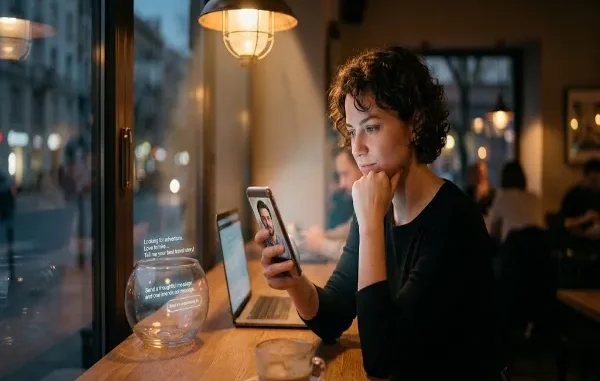
There was a time, not that long ago, when the biggest complaint about online dating was that everyone looked better in their photos than in person. That complaint hasn’t gone away, but it’s now competing with a much stranger one: was that photo even real? Did a person write that opening message, or did a chatbot? Is the “match” you’ve been talking to for three weeks an actual human being, or something else entirely?
Artificial intelligence has quietly worked its way into nearly every part of the online dating experience — the photos you post, the bios you write, the matches you’re shown, the messages you send, and unfortunately, the scams you might fall for. Some of this is genuinely useful. Some of it is a little unsettling. And almost none of it has come with a user manual.
So here’s a clear-eyed look at what’s actually changed, what it means for you as someone trying to meet another human being, and how to navigate it without losing your mind — or your money.
Why Dating Apps Turned to AI in the First Place
To understand why AI shows up everywhere in dating apps now, it helps to know what problem the apps were trying to solve. It wasn’t really about novelty. It was about survival.
Major dating platforms have spent the past couple of years dealing with a slow bleed of user fatigue and shrinking subscriber numbers. Match Group’s stock has fallen sharply over the past five years, and the company has struggled to convert free users into paying subscribers, while Bumble has also seen its share price drop significantly and reduced its workforce as paid user numbers declined. As one analyst bluntly put it, the product simply doesn’t work as well as people expect it to.
AI became the industry’s answer to swipe fatigue. Tinder has been testing a matchmaking tool that offers a curated daily set of matches based on prompts and personal data rather than endless swiping, while Bumble has announced plans for its own AI-powered product launch, Hinge has been refining its matching algorithms, and Grindr has introduced AI-driven recommendation feeds. Whether or not any of this actually fixes dating fatigue is still an open question — but the apps are betting heavily that it will.
Where You’re Actually Seeing AI Show Up
If you’ve used a dating app recently, you’ve probably encountered AI in a few specific places, even if it wasn’t labeled that way.
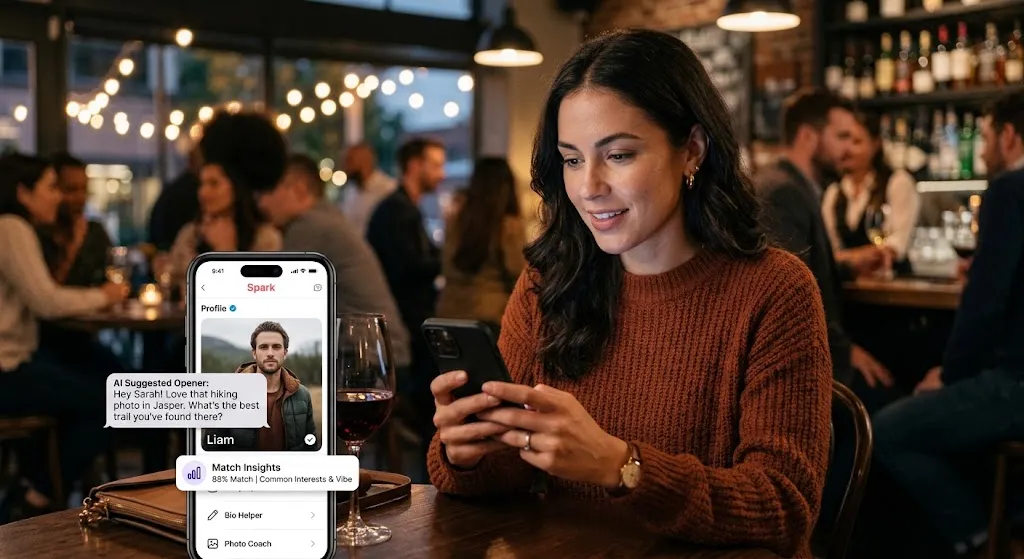
Profile and photo help. Struggling to pick which four photos make you look normal instead of like a hostage or a LinkedIn headshot? AI tools built into apps like Bumble now offer AI-powered photo feedback and profile guidance to help you choose better pictures and write a bio that doesn’t sound like everyone else’s. Tinder has similarly leaned into AI for photo selection.
Conversation starters and “wingman” tools. This is probably the most visible shift. Hinge introduced a tool to help generate more interesting conversation starters than “how are you?”, and chatbots across the industry can now suggest witty messaging banter, alter photos, and write bios and pick-up lines. Grindr has gone a step further with a dedicated AI “wingman” chatbot designed to provide dating advice and recommend suitable meeting locations.
Smarter matching. Instead of just filtering by age, distance, and a few preferences, apps are increasingly using behavior-based recommendations that analyze how users interact with profiles and conversations, rather than relying only on the preferences someone typed in.
Safety features. Not everything AI is doing is about optimizing your love life — some of it is defensive. Tinder rolled out an “are you sure?” feature that alerts users to potentially harmful language before they hit send, and Bumble has used AI to blur unsolicited explicit images and flag likely fake profiles.
Standalone AI dating apps and assistants. Beyond the big incumbents, a wave of AI-native platforms and chat assistants — with names like Iris, Rizz, and YourMove — have emerged specifically to help people write messages, choose photos, or in some cases handle entire conversations on a user’s behalf before a real human ever gets involved.
Everyone’s Using It. Almost No One’s Admitting It.
Here’s the part that makes this whole shift genuinely a little awkward: usage of AI in dating has exploded, but there’s a real gap between what people are willing to do privately and what they’re willing to admit publicly.
A survey from Match and researchers at the Kinsey Institute found that a quarter of U.S. singles reported using AI to enhance their dating — up over 300 percent from the year before. More recent estimates put usage even higher, with roughly half of daters now using some kind of AI dating tool.
And yet, in a separate survey, around 80 percent of users said they were comfortable getting AI help with their own dating profiles — but most said they’d lose interest in a match if they found out that match had used AI too. That’s a pretty striking double standard: people want the help, but they don’t want to be dating someone who needed the help.
The practical takeaway here isn’t “never use AI tools” or “assume everyone you match with is a bot.” It’s more that you should probably assume AI assistance is common and unremarkable at this point — the same way spellcheck or a filtered photo is unremarkable — while staying alert for the difference between someone using a tool to communicate better and someone using a tool to be someone they’re not.
The Genuinely Useful Part
It’s easy to be cynical about all of this, but some of it solves real problems.
If you’ve ever frozen up trying to write an opening message, or spent twenty minutes agonizing over which four photos to use, a little AI assistance can lower the barrier to just… starting. Photo feedback tools can catch things you can’t see about your own pictures. Conversation starter suggestions can break the ice with someone whose profile you don’t know how to approach. And better matching algorithms, in theory, mean less time swiping through people you’d never actually want to meet.
There’s also a case to be made that AI is addressing a structural problem with dating apps that’s existed since day one: they were built to maximize swiping, not relationships. Executives themselves have acknowledged this — Tinder’s VP of product has framed the goal as using AI to get people “efficiently to a spark and a connection” rather than keeping them swiping indefinitely.
The Part That Should Make You Pause
Now for the less comfortable part. The same technology that helps you write a better bio is also being used to build entire fake identities — and the scale of that problem has grown considerably.
Romance scams have always existed, but AI has changed their sophistication and reach. Financial institutions reported a 63 percent increase in romance scam attempts in a single year, a surge attributed to criminals using generative AI tools to create deepfake personas and hyper-personalized, convincing outreach at scale. The FTC’s numbers back this up at the macro level: investment scams — often the endgame of a romance scam — resulted in $5.7 billion in reported losses in a recent year, and experts believe the real figure is higher because many victims never report what happened.
What’s changed isn’t just the volume of scams — it’s the quality. The old advice to watch for bad grammar or blurry photos doesn’t hold up anymore. Traditional red flags like poor grammar or an inability to produce a specific photo have been largely rendered obsolete by generative AI, with scammers now using real-time deepfake video and convincingly AI-generated personas. Some scam operations have gotten disturbingly organized about it: reporting has described dedicated “AI rooms” within scam operations, where deepfake technology is used to facilitate face-swapped video calls that “prove” a scammer’s identity to a victim.
This isn’t meant to be alarmist — it’s meant to be a reason to keep a few specific habits in your back pocket.
How to Protect Yourself Without Becoming Paranoid
You don’t need to treat every match with suspicion. But a few precautions are worth building into how you use dating apps now, given how good AI-generated deception has gotten.
- Video calls aren’t as reassuring as they used to be. Requesting a video call used to be a reliable way to confirm someone was real. It still helps, but it’s no longer foolproof — ask them to do something unscripted mid-call, like touching their nose or holding up a specific number of fingers, since real-time deepfakes can struggle with sudden, unexpected movement.
- Be wary of anyone who avoids meeting in person for an extended period, especially if they offer a plausible-sounding reason for why they’re conveniently always unavailable — working abroad, on a military deployment, or on an oil rig, for instance. These “unable to meet in person” cover stories are a common thread across scam categories that federal agencies have specifically flagged.
- Any request for money, cryptocurrency, or financial “help” is a hard stop, no matter how compelling the story. This includes emergencies, investment opportunities they want to let you in on, or fees to release a gift or package.
- Reverse image search their photos. It takes thirty seconds and can catch a stolen or AI-generated photo that’s already circulating elsewhere.
- If something feels off, trust that. Scammers rely on building emotional momentum quickly so you don’t stop to question inconsistencies. A pause to verify isn’t rude — it’s reasonable.
If you do encounter something that looks like a scam, reporting it to the FTC, the FBI’s IC3 portal, and the platform itself doesn’t just help you — it helps flag patterns that protect other users too.
Where This Is Probably Headed
None of this is close to finished evolving. Dating apps are treating AI as a survival strategy, not a one-off feature launch, and the arms race between “AI that helps you date better” and “AI that helps scammers deceive you better” is likely to keep escalating in parallel.
For now, the most useful mindset is probably a fairly simple one: treat AI-assisted profiles and messages as the norm rather than the exception, use the tools that genuinely make your experience better without letting them do the entire job of being a person, and hold onto a healthy skepticism about anyone who seems a little too perfect, a little too available, or a little too eager to move things off-platform. AI can help you meet people. It can’t do the part where you actually show up as yourself.
Leave a Reply