The online gambling industry has expanded rapidly over the last decade, with millions of users participating in casino games, poker, sports wagering, and live sports bets through digital platforms. However, gambling laws differ significantly from one country to another. Some nations fully regulate and license online gambling, while others impose strict restrictions or outright bans.
It’s crucial for both operators and users to understand how these regulations operate. Various legal systems impact the protection of players, taxation, advertisements, payment processing and access to international gambling websites. Online gambling regulation is one of the fastest-growing sectors globally, as governments continue to evolve in response to technological advancements.
Why Governments Regulate Online Gambling
Most governments regulate online gambling for several purposes. Consumer protection is the main concern. Authorities want to guarantee that gambling platforms run in a fair manner, keep player data safe and secure, and do not enable gambling by minors or allow gambling fraud.
Tax revenue is another major factor. Licensed gambling operators are usually required to pay substantial taxes and licensing fees, creating an additional source of government income. Regulations also aim at curbing illegal gambling and money laundering opportunities.
There are also a number of measures of responsible gambling that are well kept in mind by many countries. Self-exclusion facilities, deposit limits and gambling-related harm support services are normally mandatory for licensed operators to offer to minimize harm caused by gambling.
Gambling Regulations in Asia
The laws of the game prohibit gambling in many Asian countries and the situation is quite different in various countries.
China
Anti-gambling laws are very strict in China. Most forms of online gambling are illegal, except for state-run lotteries. The government strictly restricts the use of offshore gambling sites and takes action against illegal gambling operators.
Many online gambling sites still try to attract Asian players with their offshore gambling sites, even with all the limitations.
Japan
In the past, Japan had a comprehensive gambling control system, but the recent changes allowed for some gambling to be legalized. Casinos are now allowed in the IRES with government oversight.
Online gambling is still not open, though a few sports betting events are permitted under the auspices of authorized systems.
Singapore
Singapore operates one of the region’s most tightly controlled gambling environments. In some regions, including Singapore, discussions around online gambling in Singapore highlight strict regulatory approaches and controlled access to platforms.
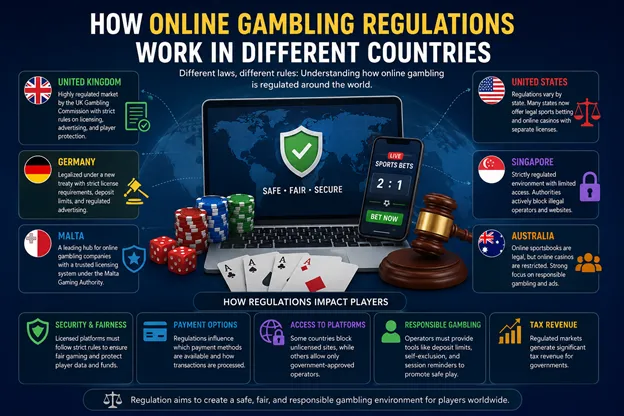
The government permits only limited forms of gambling under close supervision, while illegal gambling websites are actively monitored and blocked. Gambling Regulatory Authority enforces strict compliance standards and imposes heavy penalties on illegal operators.
Although regulations remain strict, interest in online wagering and live sports bets continues to grow among users seeking real-time betting experiences on international sporting events.
Online Gambling Regulations in Europe
European online gambling is one of the most advanced gambling markets in the world. But the rules are not regulated by a single European law, but vary from country to country.
United Kingdom
The United Kingdom is among one of the most regulated online gambling markets in the world. The UK Gambling Commission regulates license, advertising and consumer protection. Player verification and responsible gambling and anti-money laundering requirements must be adhered to by operators.
Online casinos, poker and sports betting are legal in the UK with licensed platforms. Advertising is within legal boundaries but is heavily regulated to avoid misleading advertising.
Germany
Germany had a new interstate gambling treaty, which legalized some online gambling, but only under specific conditions. Operators will need to secure local licences and adhere to restrictions on local deposits and advertising.
The market is now partially regulated, but some of the limitations are problematic for gambling companies and players because of complex licensing requirements.
Malta
The licensing framework in Malta is making it an online gambling hub. The Malta Gaming Authority is recognised in the industry worldwide and has many global operators licensed and operating internationally.
Maltese licenses are in high demand in Europe and are being issued to a variety of gambling platforms due to the country’s robust regulatory framework and business-friendly environment.
North American Gambling Laws
North America presents a mixed approach to online gambling regulation.
United States
In the United States, gambling laws differ from state to state. Other states are completely against online sports betting and online casinos; others are fully legalizing it.
Some states have very strict online gambling laws, like New Jersey, Pennsylvania, and Michigan. These states have a significant amount of tax revenue through licensed operators.
The federal sports betting ban was thrown out in 2018, and sports betting has since surged in popularity. Since then, a number of states have enacted laws to allow live sports betting and online wagering.
Each state, however, has its own regulations, so operators need to get specific licenses for each state.
Canada
The Canadian online gambling market has been slowly growing over the years. Gambling is run separately by each province, and there are now online gambling platforms available in several provinces that are regulated.
The regulated iGaming market in Ontario was introduced recently, creating the opportunity for private operators to play an online gambling role under provincial regulations.
Australia’s Approach to Online Gambling
Australia is a country with a high culture of betting particularly with sports. The Interactive Gambling Act governs online gambling services and forbids some online casinos for local people.
Licensed sportsbooks are allowed to offer sports betting services to Australian players, however. The government also has tight advertising and consumer protection regulations.
The responsible gambling aspect is an important concern in Australia and the gambling operators have to offer the tools that will enable users to manage their playing.
Middle East Gambling Restrictions
Gambling is banned in many Middle Eastern countries for religious and cultural beliefs. Saudi Arabia and United Arab Emirates have laws against gambling and with harsh penalties.
There are still some sites that offer international gambling services that are available, but there is a possibility of facing legal problems depending on local laws.
The legal online gambling industry is not widely present in most Middle Eastern countries due to the strict regulations in place.
How Regulations Affect Players
Online gambling laws have a direct effect in a number of ways on the gambling experience of players.
Security and Fairness
There is a high level of security requirement for licensed operators, and operators are required to conduct independent testing. This way, the games are fair and customer funds are safe.
Payment Processing
Payment options might be governed by regulations. Banks in restricted nations might even prohibit all gambling transactions.
Access to Platforms
Internet service provider blocking is a method that some nations employ to block gambling websites. Others accept only operators approved by the government.
Responsible Gambling Features
Operators of regulated markets typically will be mandated to offer features like deposit limits, reminders and self-exclusion options.
They are implemented to combat the issue of gambling addiction and enhance the safety of the players.
The Future of Online Gambling Regulation
Online gambling is still expanding all over the world, and there are likely to be more complex regulations in the near future. There is a growing focus on digital monitoring, AI and cross-border enforcement cooperation by governments.
Additionally, numerous nations are revisiting mobile betting applications, esports betting, and cryptocurrency gambling. The new technologies are opportunities and challenges for regulation.
At the same time, demand for live sports bets continues rising worldwide as users seek real-time betting experiences during sporting events. Regulators are expected to introduce more detailed rules covering data integrity, advertising, and player safety in this rapidly expanding sector.
Conclusion
The laws of gambling are very different from country to country. Some nations have adopted a regulated online gambling approach, like the United Kingdom and some regions of North America, while others remain with stringent limitations or complete prohibitions on online gambling.
There are legal differences that impact access to platforms, payment methods, advertising, consumer protections and more. As technology evolves, governments will continue adapting their gambling laws to balance economic benefits with public safety concerns.
Regional gambling laws are vital for players and operators to comprehend and navigate the contemporary online gambling setting safely and legally.
Leave a Reply